
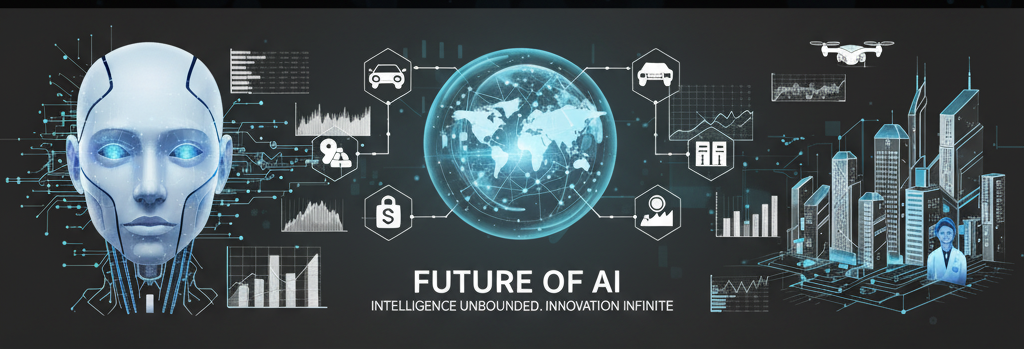
Artificial Intelligence is no longer a futuristic concept—it's reshaping how businesses operate today. As we move through 2025, AI continues to evolve at an unprecedented pace, bringing transformative changes across industries. Here are the key trends that will define the future of AI in business.
1. Generative AI Goes Mainstream
Generative AI has moved beyond experimental phases into practical business applications. Companies are leveraging tools like ChatGPT, DALL-E, and custom AI models to automate content creation, design workflows, and customer interactions.
Business Impact: Marketing teams can generate campaign assets in minutes, developers can write code faster with AI assistance, and customer service departments can provide instant, personalized responses at scale.
2. AI-Powered Decision Intelligence
The next evolution of business intelligence is here. AI systems are now capable of not just analyzing data, but providing actionable recommendations and predicting outcomes with remarkable accuracy.
- Real-time market analysis and competitor tracking
- Predictive analytics for inventory management
- Risk assessment and fraud detection
- Customer behavior prediction and personalization
3. Ethical AI and Responsible Deployment
As AI becomes more prevalent, businesses are prioritizing ethical considerations. Companies that lead in responsible AI implementation will build stronger customer trust and avoid regulatory pitfalls.
Key focus areas include transparency in AI decision-making, bias detection and mitigation, data privacy compliance, and establishing clear AI governance frameworks.
4. AI-Human Collaboration Tools
The future isn't about AI replacing humans—it's about augmentation. Smart businesses are investing in tools that enhance human capabilities rather than replace them.
Examples include: AI-assisted design tools for creative professionals, intelligent code completion for developers, augmented analytics for data scientists, and smart scheduling and productivity assistants.
5. Edge AI and Real-Time Processing
With the rise of IoT devices and the need for instant decision-making, Edge AI is becoming crucial. Processing data locally on devices rather than in the cloud enables faster response times and enhanced privacy.
6. Multimodal AI Systems
The next generation of AI systems can understand and process multiple types of data simultaneously—text, images, audio, and video. This enables more natural and comprehensive interactions.
7. AI in Cybersecurity
As cyber threats become more sophisticated, AI-powered security systems are essential. Machine learning algorithms can detect anomalies, predict attacks, and respond to threats in real-time.
Preparing Your Business for the AI Future
To stay competitive in 2025 and beyond, businesses should:
- Invest in AI literacy: Ensure your team understands AI capabilities and limitations
- Start with pilot projects: Test AI solutions in specific areas before scaling
- Prioritize data quality: AI is only as good as the data it learns from
- Partner with experts: Work with experienced AI consultants to navigate implementation
- Stay agile: The AI landscape evolves rapidly—be ready to adapt
Conclusion
The AI revolution is here, and it's accelerating. Businesses that embrace these trends and integrate AI strategically will gain significant competitive advantages. The question is no longer whether to adopt AI, but how quickly and effectively you can implement it.
At Anagha Wiz, we help businesses navigate their AI transformation journey—from strategy to implementation. Ready to future-proof your business with AI?
Get Started with AI →